A helper class for updating the triangulation, using Metropolis–Hastings algorithm. This is a high-level interface intended to implement a basic Monte-Carlo updating scheme, which should be sufficient for a lot of simple situations.
More...
#include <MonteCarloUpdater.hpp>
|
| | MonteCarloUpdater (fp::Triangulation &triangulation_inp, EnergyFunctionParameters const &prms_inp, EnergyFunctionType energy_function_inp, RandomNumberEngine &rng_inp, Real min_bond_length, Real max_bond_length) |
| |
| bool | move_needs_undoing (Real e_diff) |
| | Implementation of the Metropolis algorithm.
|
| |
| bool | new_neighbour_distances_are_between_min_and_max_length (fp::Node const &node, fp::vec3< Real > const &displacement) |
| | Pre-update check to test that the update step will not result in an unphysical configuration.
|
| |
| bool | new_next_neighbour_distances_are_between_min_and_max_length (fp::Node const &node, fp::vec3< Real > const &displacement) |
| | Pre-update check to test that the update step will not result in an unphysical configuration.
|
| |
| bool | new_verlet_neighbour_distances_are_between_min_and_max_length (fp::Node const &node, fp::vec3< Real > const &displacement) |
| | Pre-update check to test that the update step will not result in an unphysical configuration.
|
| |
| std::optional< Real > | move_MC_updater (fp::Node const &node, fp::vec3< Real > const &displacement) |
| | Attempt a move Monte Carlo Step.
|
| |
| void | flip_MC_updater (fp::Node const &node) |
| | Attempt a flip Monte Carlo Step.
|
| |
| void | flip_MC_updater (fp::Node const &node, Index id_in_nn_ids) |
| | Attempt a flip Monte Carlo Step.
|
| |
| void | reset_kBT (Real kBT) |
| | Reset the temperature of the Monte Carlo updater, at which the Boltzmann weights are evaluated.
|
| |
| Real | kBT () |
| | A getter function that returns a value of a state variable.
|
| |
| unsigned long | move_attempt_count () const |
| | A getter function that returns a value of a state variable.
|
| |
| unsigned long | bond_length_move_rejection_count () const |
| | A getter function that returns a value of a state variable.
|
| |
| unsigned long | move_back_count () const |
| | A getter function that returns a value of a state variable.
|
| |
| unsigned long | flip_attempt_count () const |
| | A getter function that returns a value of a state variable.
|
| |
| unsigned long | bond_length_flip_rejection_count () const |
| | A getter function that returns a value of a state variable.
|
| |
| unsigned long | flip_back_count () const |
| | A getter function that returns a value of a state variable.
|
| |
template<typename EnergyFunctionParameters, typename RandomNumberEngine>
class fp::MonteCarloUpdater< EnergyFunctionParameters, RandomNumberEngine >
A helper class for updating the triangulation, using Metropolis–Hastings algorithm. This is a high-level interface intended to implement a basic Monte-Carlo updating scheme, which should be sufficient for a lot of simple situations.
- Template Parameters
-
| Real | type that will be used for all floating point numbers inside this class/struct. Any data type that satisfies the floating_point_number concept is allowed, for example, float. |
| Index | type that will be used for all integer numbers inside this class/struct. Any data type that satisfies the indexing_number concept is allowed, for example, unsigned int. |
| EnergyFunctionParameters | A user-defined struct type. An instance of this struct will be part of the input of the energy function. Energy function provided during instantiation must have a third argument of type EnergyFunctionParameters const&. |
| RandomNumberEngine | type of the random number engine that will be provided during the instantiation of the class. For example std::mt19937_64. |
| triangulation_type | One of the types specified by the TriangulationType enum. This must match the type of triangulation provided during the class instantiation. |
◆ MonteCarloUpdater()
template<typename EnergyFunctionParameters , typename RandomNumberEngine >
| fp::MonteCarloUpdater< EnergyFunctionParameters, RandomNumberEngine >::MonteCarloUpdater |
( |
fp::Triangulation & | triangulation_inp, |
|
|
EnergyFunctionParameters const & | prms_inp, |
|
|
EnergyFunctionType | energy_function_inp, |
|
|
RandomNumberEngine & | rng_inp, |
|
|
Real | min_bond_length, |
|
|
Real | max_bond_length ) |
|
inline |
- Parameters
-
| triangulation_inp | Reference to the triangulation that will be updated. |
| prms_inp | The instance of the struct that contains the parameters of the system energy. |
| energy_function_inp | A c++ function that represents the system energy. It can be evaluated for a given node for a Monte Carlo step. |
| rng_inp | Random number engine |
| min_bond_length | Minimal bond length between two triangulation nodes. More generally, a minimal distance two nodes of the triangulation are allowed to have. If set to zero, the stability of the updater will suffer, and nonphysical shapes with self-intersecting triangulation will be common. |
| max_bond_length | Maximal allowed length of a bond between two nodes of a triangulation. If set too high, the stability of the updater will suffer, and nonphysical shapes with self-intersecting triangulation will be common. Conversely, setting this variable too low will significantly reduce the chance of a successful bond flip. |
◆ move_needs_undoing()
template<typename EnergyFunctionParameters , typename RandomNumberEngine >
| bool fp::MonteCarloUpdater< EnergyFunctionParameters, RandomNumberEngine >::move_needs_undoing |
( |
Real | e_diff | ) |
|
|
inline |
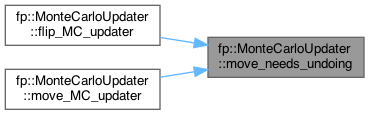
Implementation of the Metropolis algorithm.
This function implements the Metropolis algorithm to evaluate whether the performed move should be rejected and undone.
- Returns
true if the energy difference between the old and the new states is negative (i.e., the move costs energy) and the random number is smaller than the Boltzmann Probability of accepting the move. false otherwise.
◆ new_neighbour_distances_are_between_min_and_max_length()
template<typename EnergyFunctionParameters , typename RandomNumberEngine >
| bool fp::MonteCarloUpdater< EnergyFunctionParameters, RandomNumberEngine >::new_neighbour_distances_are_between_min_and_max_length |
( |
fp::Node const & | node, |
|
|
fp::vec3< Real > const & | displacement ) |
|
inline |
◆ new_next_neighbour_distances_are_between_min_and_max_length()
template<typename EnergyFunctionParameters , typename RandomNumberEngine >
| bool fp::MonteCarloUpdater< EnergyFunctionParameters, RandomNumberEngine >::new_next_neighbour_distances_are_between_min_and_max_length |
( |
fp::Node const & | node, |
|
|
fp::vec3< Real > const & | displacement ) |
|
inline |
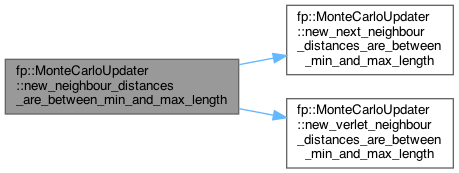
Pre-update check to test that the update step will not result in an unphysical configuration.
Iterate through the next neighbor distances of a node which is a collection of 3d vectors, i.e. nn_dist is of type fp::vec3. Then check if the displacement would make any of the nn_distance vectors longer than the allowed max length.
- Parameters
-
| node | The reference to the node being updated. |
| displacement | Displacement vector, by which the node will be moved (if the move is accepted). |
- Returns
true if all next neighbor distances are between minimal and maximal allowed values, provided during the instantiation of the MonteCarloUpdater class, false otherwise.
◆ new_verlet_neighbour_distances_are_between_min_and_max_length()
template<typename EnergyFunctionParameters , typename RandomNumberEngine >
| bool fp::MonteCarloUpdater< EnergyFunctionParameters, RandomNumberEngine >::new_verlet_neighbour_distances_are_between_min_and_max_length |
( |
fp::Node const & | node, |
|
|
fp::vec3< Real > const & | displacement ) |
|
inline |
Pre-update check to test that the update step will not result in an unphysical configuration.
Iterate through the Verlet list neighbor distances of a node which is a collection of 3d vectors. Then check if the displacement would make any of the Verlet list neighbors move closer than the minimal allowed distance between two nodes. I.e., we check if the node would overlap with any of its Verlet list neighbors after the move. The overlap distance or the minimal allowed distance is provided during the instantiation of the class.
- Parameters
-
| node | The reference to the node being updated. |
| displacement | Displacement vector, by which the node will be moved (if the move is accepted). |
- Returns
true if the nodes did not overlap before but overlap now. false otherwise.
◆ move_MC_updater()
template<typename EnergyFunctionParameters , typename RandomNumberEngine >
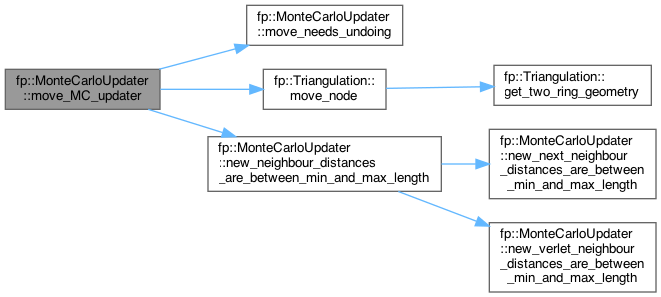
Attempt a move Monte Carlo Step.
A move step is attempted on the specified node. Metropolis algorithm is used to evaluate whether the move should be accepted.
- Parameters
-
| node | The reference to the node being updated. |
| displacement | Displacement vector, by which the node will be moved (if the move is accepted). |
- Returns
- This function returns the calculated energy difference. If not energy difference was calculated due to bond_length constraint rejection, then an empty optional is returned.
◆ flip_MC_updater() [1/2]
template<typename EnergyFunctionParameters , typename RandomNumberEngine >
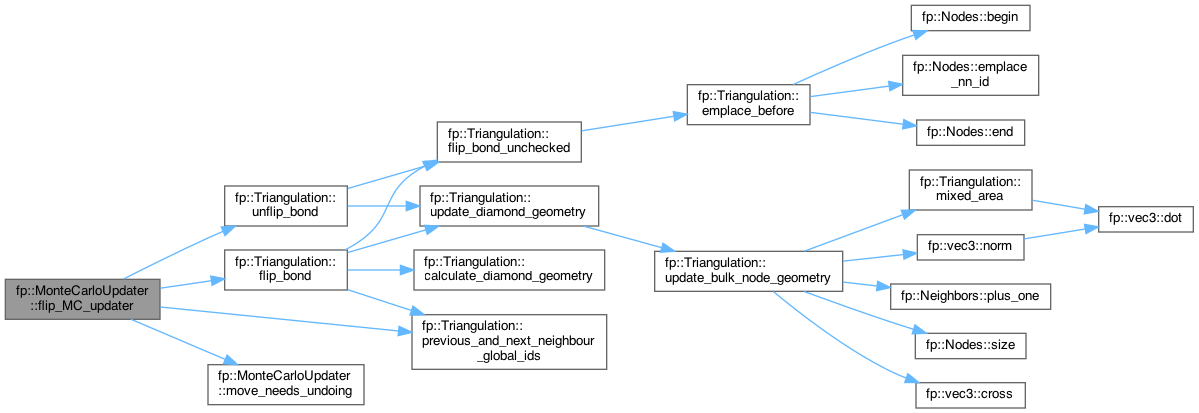
Attempt a flip Monte Carlo Step.
A flip step is attempted between a specified node and one of its randomly chosen next neighbors. Metropolis algorithm is used to evaluate whether the flip should be accepted.
- Parameters
-
| node | The reference to the node being updated. otherwise, the flippy will fail silently. |
- Note
- This function randomly chooses the next neighbor of the
node and flips the edge between them. If more precise control is required, i.e., if it is necessary to control exactly which edge needs to be flipped, then the flip_MC_updater(fp::Node const& node, Index id_in_nn_ids) method can be used.
◆ flip_MC_updater() [2/2]
template<typename EnergyFunctionParameters , typename RandomNumberEngine >
Attempt a flip Monte Carlo Step.
A flip step is attempted between a specified node and its specified next neighbor. Metropolis algorithm is used to evaluate whether the flip should be accepted.
- Parameters
-
| node | The reference to the node being updated. |
| id_in_nn_ids | This id must be part of the Node::nn_ids vector of the node provided in the first argument , otherwise, the flippy will fail silently. |
- Warning
- For performance reasons, this function does not check if
id_in_nn_ids is really a nn_id of the node provided in the first argument. The user is required to guarantee this fact. Otherwise, flippy will fail unpredictably. flip_MC_updater(fp::Node const&) is the safer method if the user does not care exactly which bond is flipped.
◆ reset_kBT()
template<typename EnergyFunctionParameters , typename RandomNumberEngine >
Reset the temperature of the Monte Carlo updater, at which the Boltzmann weights are evaluated.
- Parameters
-
| kBT | input value of new temperature. The internal private data member kBT_ that contains the current value of temperature will be overwritten with this input. |
◆ kBT()
template<typename EnergyFunctionParameters , typename RandomNumberEngine >
A getter function that returns a value of a state variable.
Monte Carlo Updater requires a kBT value in the calculation of the rejection probability of a random move.
- Returns
- the state of the kBT value of the updater.
- See also
- move_needs_undoing()
◆ move_attempt_count()
template<typename EnergyFunctionParameters , typename RandomNumberEngine >
| unsigned long fp::MonteCarloUpdater< EnergyFunctionParameters, RandomNumberEngine >::move_attempt_count |
( |
| ) |
const |
|
inlinenodiscard |
A getter function that returns a value of a state variable.
Every time a move is attempted, a private internal state variable move_attempt is incremented by move_MC_updater(). This variable can be used for diagnostics or statistical tracking, but its state does not impact the function of the updater.
- Returns
- current state of
move_attempt.
- See also
- move_needs_undoing()
◆ bond_length_move_rejection_count()
template<typename EnergyFunctionParameters , typename RandomNumberEngine >
| unsigned long fp::MonteCarloUpdater< EnergyFunctionParameters, RandomNumberEngine >::bond_length_move_rejection_count |
( |
| ) |
const |
|
inlinenodiscard |
A getter function that returns a value of a state variable.
Moves that cause nodes to overlap with their Verlet list neighbors or move them too far away from any of their next neighbors are rejected. Every time such rejection happens, a private internal state variable bond_length_move_rejection is incremented by move_MC_updater(). The specifics of this rejection criteria are calculated in the function new_neighbour_distances_are_between_min_and_max_length(fp::Node const& node, fp::vec3<Real> const& displacement) Every time a node move would lead that node to have a bond with one of its next neighbors, which is longer than a specified maximal length (max_bond_length()), the move will be rejected. This variable can be used for diagnostics or statistical tracking, but its state does not impact the function of the updater.
- Returns
- current state of
bond_length_move_rejection.
- See also
- move_needs_undoing()
◆ move_back_count()
template<typename EnergyFunctionParameters , typename RandomNumberEngine >
| unsigned long fp::MonteCarloUpdater< EnergyFunctionParameters, RandomNumberEngine >::move_back_count |
( |
| ) |
const |
|
inlinenodiscard |
A getter function that returns a value of a state variable.
Every time a move is rejected because the energy requirement was not satisfied, a private internal state variable move_back is incremented by move_MC_updater(). This variable does not track the rejections resulting from bond length restriction violations. This variable can be used for diagnostics or statistical tracking, but its state does not impact the function of the updater.
- Returns
- current state of
move_back.
- See also
- move_needs_undoing() bond_length_move_rejection_count()
◆ flip_attempt_count()
template<typename EnergyFunctionParameters , typename RandomNumberEngine >
| unsigned long fp::MonteCarloUpdater< EnergyFunctionParameters, RandomNumberEngine >::flip_attempt_count |
( |
| ) |
const |
|
inlinenodiscard |
A getter function that returns a value of a state variable.
Every time a flip is attempted, a private internal state variable flip_attempt is incremented by flip_MC_updater() and flip_MC_updater(fp::Node const& node, Index index_in_nn_ids). This variable can be used for diagnostics or statistical tracking, but its state does not impact the function of the updater.
- Returns
- current state of
flip_attempt.
◆ bond_length_flip_rejection_count()
template<typename EnergyFunctionParameters , typename RandomNumberEngine >
| unsigned long fp::MonteCarloUpdater< EnergyFunctionParameters, RandomNumberEngine >::bond_length_flip_rejection_count |
( |
| ) |
const |
|
inlinenodiscard |
◆ flip_back_count()
template<typename EnergyFunctionParameters , typename RandomNumberEngine >
| unsigned long fp::MonteCarloUpdater< EnergyFunctionParameters, RandomNumberEngine >::flip_back_count |
( |
| ) |
const |
|
inlinenodiscard |
A getter function that returns a value of a state variable.
Every time a flip is rejected because the energy requirement was not satisfied, a private internal state variable flip_back is incremented by flip_MC_updater() and flip_MC_updater(fp::Node const& node, Index index_in_nn_ids). The rejection of flips is handled by the Triangulation class itself and reported through the BondFlipData to the flip functions of the updater. This variable does not track the rejections resulting from bond length restriction violations. This variable can be used for diagnostics or statistical tracking, but its state does not impact the function of the updater.
- Returns
- current state of
flip_back.
- See also
- Triangulation:: unflip_bond(Index node_id, Index nn_id, BondFlipData const& common_nns) bond_length_flip_rejection_count()
The documentation for this class was generated from the following file:






 1.11.0