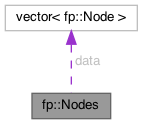
Data structure containing all nodes of the Triangulation.
More...
#include <Nodes.hpp>
|
|
| Nodes ()=default |
| | Default constructor.
|
| |
| | Nodes (std::vector< Node > data_inp) |
| | Constructor from a vector.
|
| |
| | Nodes (Json const &node_dict) |
| | Constructor from JSON.
|
| |
| std::vector< Node >::iterator | begin () |
| | Returns an iterator to the beginning of the underlying data member that contains the collection of the nodes.
|
| |
| std::vector< Node >::const_iterator | begin () const |
| | This is an overloaded member function, provided for convenience. It differs from the above function only in what argument(s) it accepts.
|
| |
| std::vector< Node >::iterator | end () |
| | Returns an iterator to the end of the underlying data member that contains the collection of the nodes.
|
| |
| std::vector< Node >::const_iterator | end () const |
| | This is an overloaded member function, provided for convenience. It differs from the above function only in what argument(s) it accepts.
|
| |
| void | emplace_nn_id (Index node_id, Index to_emplace_nn_id, Index loc_nn_index) |
| | Emplace a the id of a new node in the Node::nn_ids vector, in front of the loc_idx position.
|
| |
| void | set_nn_distance (Index node_id, Index loc_nn_index, vec3< Real > &&dist) |
| | Overwrite the next neighbor distance with a new 3d vector.
|
| |
| void | set_nn_distance (Index node_id, Index loc_nn_index, vec3< Real > const &dist) |
| | This is an overloaded member function, provided for convenience. It differs from the above function only in what argument(s) it accepts.
|
| |
| Index | size () const |
| | Size of the Nodes data member.
|
| |
| Node & | operator[] (Index node_id) |
| | Square bracket operator overload for convenient indexing of the Nodes struct.
|
| |
| const Node & | operator[] (Index node_id) const |
| | This is an overloaded member function, provided for convenience. It differs from the above function only in what argument(s) it accepts.
|
| |
| Json | make_data () const |
| | Serialize the Nodes struct to a JSON object.
|
| |
|
|
std::vector< Node > | data |
| | Data member that contains the individual nodes.
|
| |
Data structure containing all nodes of the Triangulation.
The Nodes struct is capable of reinitializing nodes from a well-formed JSON object or from a simple std::vector that contains all nodes of a triangulation. The nodes class is basically a wrapper around a vector of nodes, i.e., std::vector<Node>, and provides additional functionality to manipulate and query this data structure. Nodes class is also meant to be the interface with which the end user is manipulating individual nodes.
- Template Parameters
-
| Real | type that will be used for all floating point numbers inside this class/struct. Any data type that satisfies the floating_point_number concept is allowed, for example, float. |
| Index | type that will be used for all integer numbers inside this class/struct. Any data type that satisfies the indexing_number concept is allowed, for example, unsigned int. |
◆ Nodes() [1/2]
| fp::Nodes::Nodes |
( |
std::vector< Node > | data_inp | ) |
|
|
inlineexplicit |
Constructor from a vector.
Copies the data from a vector of nodes and creates a new Nodes struct.
- Parameters
-
| data_inp | A standard vector containing all the nodes that are supposed to create a new Nodes class. |
◆ Nodes() [2/2]
| fp::Nodes::Nodes |
( |
Json const & | node_dict | ) |
|
|
inlineexplicit |
Constructor from JSON.
Initiating nodes from a JSON object of a node collection. The nodes in the JSON file must be sequentially numbered from 0 to Number_of_nodes - 1.
- Parameters
-
| node_dict | JSON object that contains a collection of nodes. |
- Warning
- If the JSON object is malformed, then the constructor will fail and propagate a runtime error from the JSON parser.
◆ begin() [1/2]
| std::vector< Node >::iterator fp::Nodes::begin |
( |
| ) |
|
|
inline |
Returns an iterator to the beginning of the underlying data member that contains the collection of the nodes.
This function allows the Nodes struct to be used in range-based for loops.
- Returns
data.begin()
◆ begin() [2/2]
| std::vector< Node >::const_iterator fp::Nodes::begin |
( |
| ) |
const |
|
inlinenodiscard |
This is an overloaded member function, provided for convenience. It differs from the above function only in what argument(s) it accepts.
This function allows the Nodes struct to be used in range-based for loops in constant environments.
- Returns
- a constant iterator
data.begin().
◆ end() [1/2]
| std::vector< Node >::iterator fp::Nodes::end |
( |
| ) |
|
|
inline |
Returns an iterator to the end of the underlying data member that contains the collection of the nodes.
This function allows the Nodes struct to be used in range-based for loops.
- Returns
data.end().
◆ end() [2/2]
| std::vector< Node >::const_iterator fp::Nodes::end |
( |
| ) |
const |
|
inlinenodiscard |
This is an overloaded member function, provided for convenience. It differs from the above function only in what argument(s) it accepts.
This function allows the Nodes struct to be used in range-based for loops in constant environments.
- Returns
- a constant iterator
data.end().
◆ emplace_nn_id()
| void fp::Nodes::emplace_nn_id |
( |
Index | node_id, |
|
|
Index | to_emplace_nn_id, |
|
|
Index | loc_nn_index ) |
|
inline |
Emplace a the id of a new node in the Node::nn_ids vector, in front of the loc_idx position.
This function is a wrapper around Node::emplace_nn_id(Index , vec3<Real> const& , Index).
- Parameters
-
| node_id | Global id of the Node, which is a number between 0 and max_number_of_nodes - 1. |
| to_emplace_nn_id | Global id of the next neighbor Node, which is a number between 0 and max_number_of_nodes - 1. |
| loc_nn_index | Local index in the Node::nn_ids vector, a number between 0 and Node::nn_ids.size() - 1. |
◆ set_nn_distance() [1/2]
| void fp::Nodes::set_nn_distance |
( |
Index | node_id, |
|
|
Index | loc_nn_index, |
|
|
vec3< Real > && | dist ) |
|
inline |
Overwrite the next neighbor distance with a new 3d vector.
- Parameters
-
| node_id | Global id of the next neighbor Node, which is a number between 0 and max_number_of_nodes - 1. |
| loc_nn_index | Local index in the Node::nn_ids vector, a number between 0 and Node::nn_ids.size() - 1. |
| dist | rvalue reference to a 3D distance vector (that points from node_id to its next neighbour). |
◆ set_nn_distance() [2/2]
| void fp::Nodes::set_nn_distance |
( |
Index | node_id, |
|
|
Index | loc_nn_index, |
|
|
vec3< Real > const & | dist ) |
|
inline |
This is an overloaded member function, provided for convenience. It differs from the above function only in what argument(s) it accepts.
- Parameters
-
| node_id | Global id of the next neighbor Node, which is a number between 0 and max_number_of_nodes - 1. |
| loc_nn_index | Local index in the Node::nn_ids vector, a number between 0 and Node::nn_ids.size() - 1. |
| dist | lvalue constant reference to a 3D distance vector (that points from node_id to its next neighbour). |
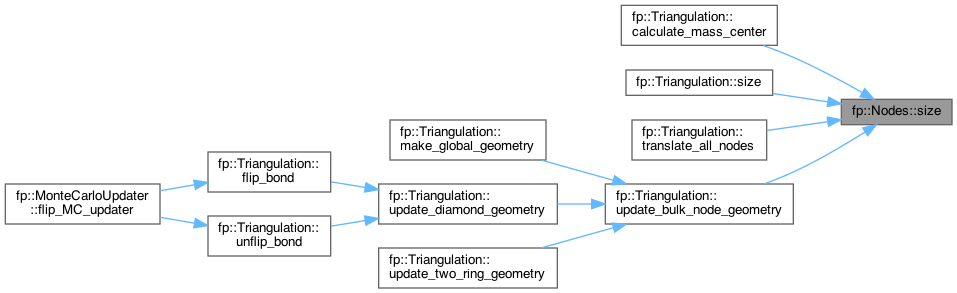
◆ size()
| Index fp::Nodes::size |
( |
| ) |
const |
|
inlinenodiscard |
Size of the Nodes data member.
- Returns
- Size of the data vector, same as the number of nodes.
◆ operator[]() [1/2]
| Node & fp::Nodes::operator[] |
( |
Index | node_id | ) |
|
|
inline |
Square bracket operator overload for convenient indexing of the Nodes struct.
Nodes[node_id] is the same as Nodes.data[node_id].
- Parameters
-
| node_id | Global id of the Node, which is a number between 0 and max_number_of_nodes - 1. |
- Returns
- Reference to the Node struct with the id corresponding to node_id.
◆ operator[]() [2/2]
| const Node & fp::Nodes::operator[] |
( |
Index | node_id | ) |
const |
|
inline |
This is an overloaded member function, provided for convenience. It differs from the above function only in what argument(s) it accepts.
Nodes[node_id] in the constant environment is the same as Nodes.data.at(node_id).
- Parameters
-
| node_id | Global id of the Node, which is a number between 0 and max_number_of_nodes - 1. |
- Returns
- Constant reference to the Node struct with the id corresponding to node_id.
◆ make_data()
| Json fp::Nodes::make_data |
( |
| ) |
const |
|
inlinenodiscard |
Serialize the Nodes struct to a JSON object.
- Returns
- JSON object that represents a serialization of the data contained in Nodes. This JSON object can later be used to reconstruct the Nodes object.
The documentation for this struct was generated from the following file:




 1.11.0